

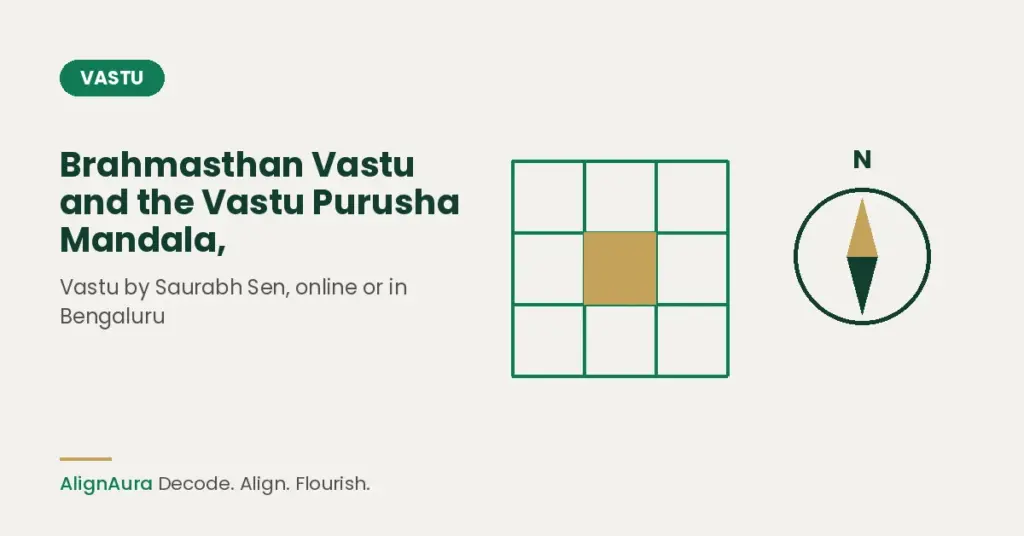
Short answer: The Brahmasthan is the centre of a home in Vastu, the central block of the Vastu Purusha Mandala where Brahma sits. It should stay open, light and uncluttered: no toilet, staircase, kitchen, heavy storage or exposed beam. In flats, where a pillar or wall often falls there, I start by clearing and lighting the space.
The mandala in plain words
The Vastu Purusha Mandala is a square grid laid over a plot or a floor plan. For homes, the version most used is nine squares by nine, which gives 81 small squares called padas. Temples often use eight by eight, which gives 64. Forty-five deities are placed on the grid: 32 around the edge and 13 inside.
The story behind it is short. A formless being was pressed face down into the earth, and the deities held him in place. He lies with his head in the north-east and his feet in the south-west, and Brahma sits at the centre of his body. You do not need to believe the story to use the grid. In practice it tells me two things: which parts of a house should stay light and which can carry weight, and that the centre belongs to everyone who lives there.
Jyotish has a matching idea that I use often. The 1st house of a chart is the person’s own centre, and when the lagna is under strain, a cluttered middle of the home tends to be felt more sharply by that person.
How big is the Brahmasthan?
On the 81-square grid, Brahma takes the central nine squares, a three by three block. That is one ninth of the floor area. On the 64-square grid it is the central four. So on a 1,200 sq ft flat, the Brahmasthan is roughly 130 sq ft, about the size of a small room, not a dot in the middle.
I find the centre from the geometry of the whole plan, not from the middle of the living room. For an L-shaped or cut plan, the centre shifts towards the larger mass, and I mark it on the plan before reading anything else. The 16 Vastu zones are all measured outward from this point, which is why getting it right comes first.
What sits in your centre, and what I do about it
| Found in the centre | My view | First step, no demolition |
|---|---|---|
| Open floor, passage or living area | Ideal | Keep it clear of furniture and boxes |
| Structural pillar | Common in flats, cannot be touched | Keep it bare, light-coloured and well lit; build no storage around it |
| Beam overhead | Avoid sitting or sleeping under it | Move seating out from under the beam |
| Toilet | The most serious case | Door shut, dry and spotless, exhaust working; we plan the rest on the call |
| Staircase (duplex or villa) | Avoid | Keep the area under it empty |
| Kitchen or heavy storage | Avoid | Shift heavy cupboards to the south or west walls |
The Brahmasthan in Bangalore flats
In most apartments here, the centre lands in the long hall that holds the sofa and the dining table, or in the passage between bedrooms. Both are usually fine. The trouble cases are a shared duct, the back wall of a toilet, or a thick column in the middle of the hall. Structural columns stay. What I change is around them: no wardrobe built against the pillar, no shoe cabinet or box stack in that block, a ceiling light that keeps it bright in the evening. A light dining table is acceptable in the centre; a heavy sideboard is not.
If a flat already has a toilet near the centre, the correction steps are on my toilet Vastu remedies page.
Independent houses and new construction
If you are building, the centre is the easiest thing to protect on paper and the hardest to fix later. Older homes in South India kept it open as a courtyard, the nadumuttam in Kerala houses, and many North Indian havelis had a chowk in the same place. You need not build a courtyard. A double-height hall, a skylight, or simply no stair and no toilet in that block does the job. Plan it with the rest of the structure using my house construction Vastu notes.
How this fits my reading of your home
Every consultation starts here: I place the grid, find the centre, then read the zones around it, and only then move to the rooms. The steps of a session are on how a consultation works, and the room-by-room basics are in Vastu for home.
The centre of your home and the centre of your chart
Clearing the Brahmasthan helps everyone in the house. Looking at the owner’s chart beside it tells me who it matters to most and when. I treat the lagna and its lord as the chart’s own centre. Say the lagna lord is weak and a pillar or a toilet wall sits in the Brahmasthan: I would push the clearing and lighting work up the list, and time any larger change for a stronger dasha period.
Finding your centre and clearing it is part of every ₹1,499 home Vastu call. For the fuller picture, where the grid and your birth chart are studied in one sitting, see my Astro-Vastu sessions.
Have your centre marked
Send me the floor plan with north marked, and I will show you where your Brahmasthan falls and what to clear first. Home Vastu is ₹1,499 for one floor or one flat, on a 45-minute call online or at my Begur studio, with the written report in 48 hours. Read about my Vastu consultation in Bangalore, or book your session.
Frequently Asked Questions
What should be kept in the Brahmasthan?
As little as possible. Open floor, good light and fresh air are what the centre needs. A rug, a low table or a light dining set is fine. Avoid heavy cupboards, stored boxes, plants in large pots and anything that makes the space feel crowded.
Can a toilet be in the centre of the house?
It is the placement I take most seriously, but it is not a reason to panic or to break walls straight away. Keeping it shut, dry and clean is the first step, and the rest depends on the full plan and where the other zones stand.
Who is the Vastu Purusha?
In the old texts, a being pressed into the earth and held down by 45 deities, head to the north-east and feet to the south-west. The image is a way of mapping which parts of a plot are sensitive and which can take load.
Is the Brahmasthan the same as the centre of the living room?
No. It is the centre of the whole floor plan. In many flats it falls somewhere in the hall, but it can just as easily land in a passage or near a bedroom door.
Is a pillar in the Brahmasthan a problem?
In flats it is very common and you cannot remove a structural column. Keep it bare and well lit, do not box it in with storage, and keep heavy furniture away from it. That is usually enough.