

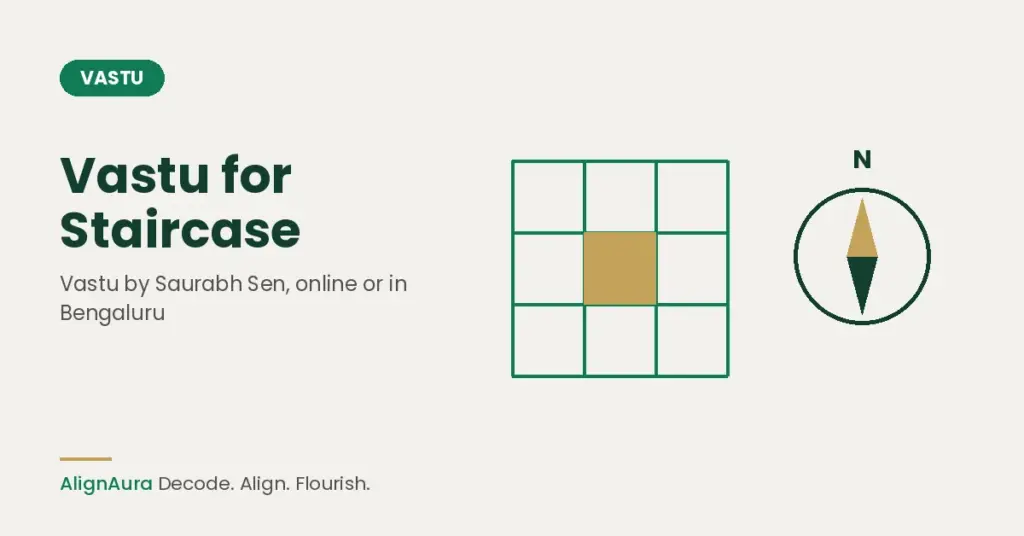
Short answer: Vastu for staircase comes down to a few rules: place the stairs in the south, west or south-west of the house, never in the north-east or the centre. Climb from north to south or from east to west, so the turn goes clockwise. Keep the risers even, the treads solid, and the space underneath for closed storage only.
Why the staircase goes south or west
A staircase is the heaviest thing inside most houses: a block of concrete or steel rising through the building. Vastu wants weight in the south and west and openness in the north and east, so the stairs belong on the heavier side. In a duplex or a villa I look for them first on the south wall, the west wall or in the south-west quarter. The south-east and the north-west are fair second choices if the stairs stay close to the outer walls.
The two places I resist are the north-east and the centre. The north-east should be the lightest part of the home, and the centre should stay open. A stair in the middle of the plan is common in modern villas with a double-height hall; what can be done about it is on my Brahmasthan page. The wider room-by-room picture is in my Vastu guide for the home.
The same stair can also read differently from one owner to the next. A west staircase can sit quietly for one owner and feel like a burden to another, depending on which planets they happen to be running.
Staircase placement at a glance
| Position of the stair | My view |
|---|---|
| South-west | Best |
| South | Good |
| West | Good |
| South-east | Workable, kept near the outer wall |
| North-west | Workable, kept near the outer wall |
| North or east | Avoid if you are still designing |
| North-east | Avoid |
| Centre of the house | Avoid |
Clockwise turns and which way you climb
Someone going up should move from north towards south, or from east towards west. When the stair turns, the turn should be clockwise as you climb. Picture yourself on the first step with the east behind you: you go up facing west, and at the landing you turn right. Anti-clockwise stairs are the thing I flag most often on duplex drawings, and they are easiest to change before the slab is cast.
A dog-legged stair with one landing is the simplest shape to get right. A straight flight is fine if it runs north to south or east to west. For the main stair I steer people away from spirals; a small spiral for terrace access does no harm.
Duplex flats and villas
In a duplex flat the builder has usually fixed the stair, and we work around it. If it turns anti-clockwise or sits in the north-east, keep that part of the home very light: pale walls, good lighting and nothing stored on the landing. Put the heavier furniture in the south-west of the lower floor to balance it.
In a villa you can still choose. I check three things on the plan: the stair is in the south or west half, it does not start right in front of the main door, and it does not end facing a toilet door upstairs. Those three cover most of what goes wrong. Builders in gated villa projects often repeat one stair design across every facing, so a layout that works for a west-facing villa can be wrong for the east-facing one opposite. The facing guides for an east-facing house and a west-facing house show where the stair usually sits in each.
Steps, railings and light
- Number of steps: many families like an odd number, and an old count says the total divided by three should leave two. I treat this as a custom, not a rule that should hold up a design.
- Every riser the same height. Uneven steps worry me more than the count.
- No broken or chipped treads. Repair them quickly.
- A light at the top and at the bottom, and the stair never left dark at night.
- Solid treads in wood or stone. Glass or open risers are acceptable in a modern home if they feel safe underfoot.
- No shared wall between the stair and the pooja unit.
What to keep under the stairs
The space under the stairs suits closed storage: suitcases, seasonal clothes, a vacuum cleaner, a toolbox. A cupboard with doors is better than open heaps. I do not put a pooja unit, a toilet, a cooking counter, a bed or a work desk under a stair. Sitting, praying or working under a slope that people walk over is what I avoid.
A shoe cupboard under the stairs is acceptable as long as the stair is not right beside the main door. My shoe rack Vastu notes go into where shoes sit best.
Climbing through saturn’s side of the house
A staircase in the west is classically sound. The chart tells me whether that is the end of the story. The west is Saturn’s direction, so for someone in a Saturn mahadasha or in sade sati, the west is the zone working hardest for them right now, and a dark, cluttered stair on that side is the first thing I would want lit and cleared.
The plain placement check is part of my ₹1,499 home Vastu session. If you are building or buying a duplex during a demanding period, an Astro-Vastu consultation lets me read the stair, the plan and your dasha in one sitting, so the remedies come in the right order for you.
Send me the stair before it is built
If your house is still on paper, send me the drawings now; turning a stair costs nothing at the design stage and a great deal later. If it is already built, a photo of the stair and the floor plan with north marked are enough. Home Vastu is ₹1,499 per floor, on a 45-minute call online or at my Begur studio, with the written report within 48 hours. Here is how my Vastu consultation in Bangalore works, and you can book your session here.
Frequently Asked Questions
Is an outside staircase better than an inside one?
An outside stair is common when the upper floor is let out, and it follows the same direction rules: south, west or south-west of the plot, turning clockwise. It should not cut across the main entrance or block the north-east of the compound.
My existing staircase is anti-clockwise. Do I need to rebuild it?
No. I do not ask anyone to break a finished stair. Keep it well lit, keep the landing empty, place something heavy and steady in the south-west of the floor, and avoid storing clutter beneath it. Those changes carry most of the correction.
Can a staircase start from the living room?
Yes, an open stair from the hall is very common and acceptable. Check that it starts on the south or west side of the room and that the first step does not face the main door directly. A low planter or console at the foot softens the line.
Is a north-east staircase in a duplex flat a serious problem?
It is one of the weaker positions, but it can be managed. Keep that corner bright and light in colour, never use the space under it for storage, and put the weight of the home in the south-west. I also check which floor the bedrooms are on.
Which material is best for a staircase: wood, stone or steel?
Vastu prefers solid, steady material, so stone, concrete and wood are all good. Steel is fine when it does not shake or ring as you climb. What I look for is that every step feels firm and that the stair is quiet to use.