
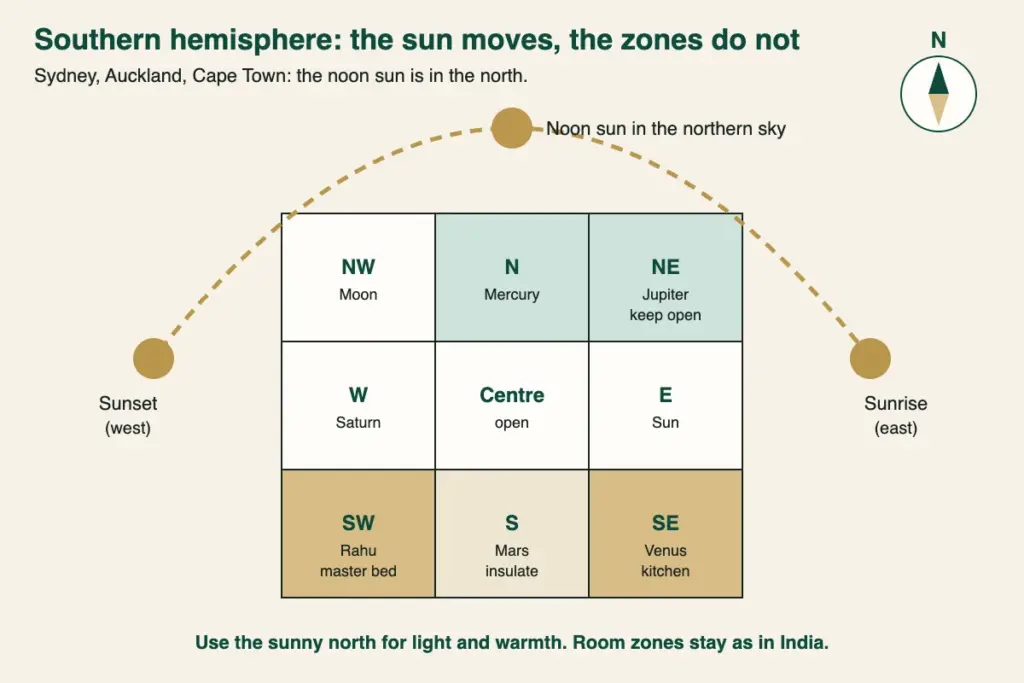
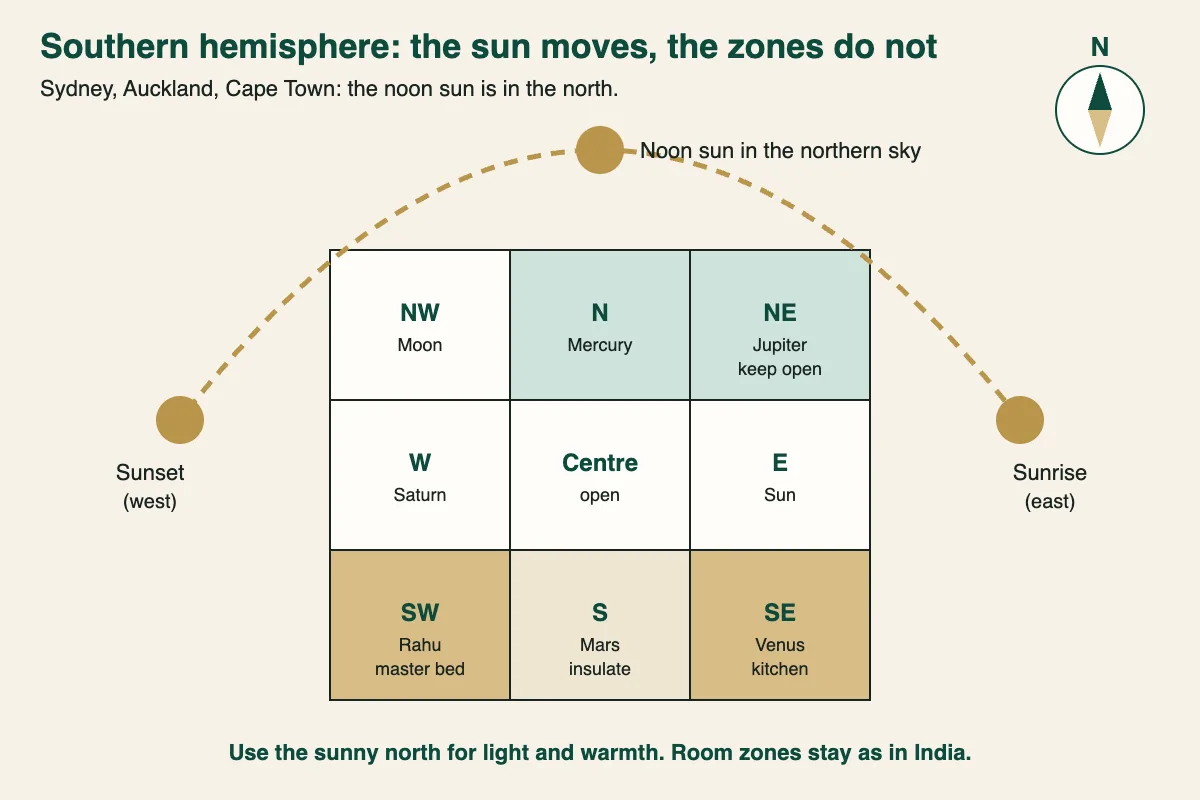
Short answer: In the southern hemisphere I do not flip Vastu. North stays north, the north-east stays the zone to keep open, and the south-west stays the heavy zone, in Sydney as in Bengaluru. What does change is the sun: in Australia, New Zealand and South Africa the north is the sunny side, so I use that for light and warmth, while the zone rules stay the same.
Updated 3 November 2026
Should Vastu be reversed in the southern hemisphere?
No, not in my practice. Some practitioners mirror the rules south of the equator, swapping north and south, because the sun sits in the northern sky there. I keep the directions as they are, and I explain why below, because this is a reasoned position and you should be able to judge it for yourself.
Vastu is built on the Vastu Purusha Mandala, a square grid laid on the eight directions, with each direction given a planet. The Sun rules the east, Mercury the north, Jupiter the north-east, Venus the south-east, Mars the south, Rahu the south-west, Saturn the west and the Moon the north-west. If you flip the rules in Melbourne, you also have to argue that Mercury now rules the south and Mars the north. I have never seen a convincing case for that.
Why don’t the directions and their planets flip?
Because they are tied to the earth, not to where the noon sun happens to stand. Three things stay exactly the same on both sides of the equator.
| What Vastu relies on | North of the equator | South of the equator |
|---|---|---|
| The sun rises in the | East | East |
| The sun sets in the | West | West |
| North points to the | Earth’s axis, the north pole | Earth’s axis, the north pole |
| The planet for each direction | Fixed by tradition | Same, unchanged |
| The noon sun sits in the | Southern sky | Northern sky |
Only the last row changes. East is the direction of sunrise everywhere, which is why the east and north-east stay the zones of new beginnings and light. North is the same axis everywhere. The noon sun’s position is a matter of heat and light, and that is where I do take the southern hemisphere into account.
I will be straight with you: no one has proved this either way. The texts were written in India, for India, and never addressed the question. What I can promise is that I apply one logic consistently, and I tell you when a decision rests on climate rather than on Vastu.
How do you use the north being the sunny side?
For light and warmth only. In Australia, New Zealand and South Africa, a north-facing living room gets the winter sun and is the warmest, brightest room in the house. I am happy to use that, and it fits Vastu well, because the north and north-east are the zones I want open and bright anyway.
| Decision | What I follow | Why |
|---|---|---|
| Where the main living area goes | North or east, with big windows | Vastu wants it open, and the sun makes it warm |
| Where the kitchen goes | South-east, then north-west | Zone rule, unchanged |
| Where the master bedroom goes | South-west | Zone rule, unchanged |
| Pooja or meditation corner | North-east | Zone rule, unchanged |
| Heating and insulation | Extra on the south side | The south is the cold, shaded side here |
| Shading and blinds | West windows | Hot afternoon sun, as in India |
The one real tension is the south-west bedroom. Down south, it is on the cool, shaded side, and in a Melbourne or Christchurch winter it can be cold. My answer is not to move the bedroom but to warm it: good insulation, heavier curtains, a rug, warmer colours. The south-west wants weight anyway, so these fit.
Which facing house is best in Australia or New Zealand?
North-facing, if you can choose, because it is good in Vastu and gets the sun on its main rooms. East-facing is the other easy choice. A south or west facing house is fine as long as the main door sits on a good pada of its wall.
Australian builders often talk about “orientation” for energy ratings, and the advice there is to put the living areas on the north. Vastu agrees with this, for its own reasons. Where the two part ways is the master bedroom. Energy advice may say put it on the cool south side for summer; Vastu says south-west. Those overlap well in practice, since the south-west is on the cool side too.
What does this look like in Australia, New Zealand and South Africa?
The same zone rules, with the local house type read sensibly. Here is what I usually find in each country.
Australia
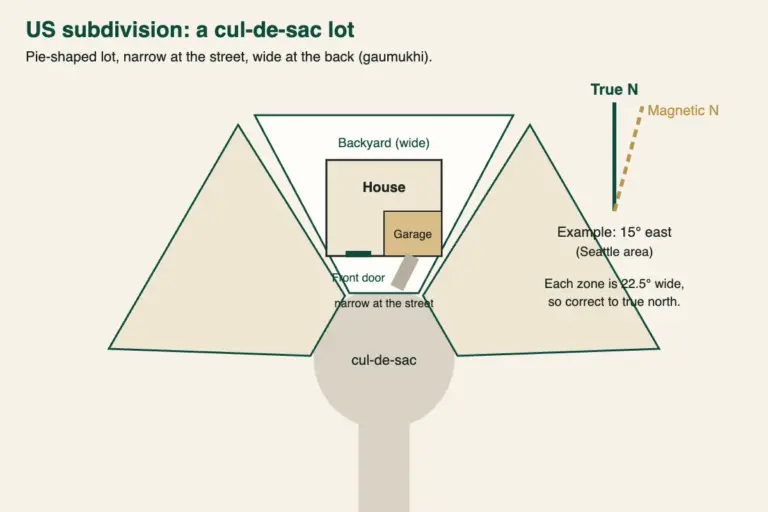
Most homes are detached houses on suburban blocks, with a garage at the front and a backyard behind. Builders market “north-facing backyards” because of the sun, and that suits Vastu well: open, green space on the north side. Inside, I read the kitchen by where the cooktop sits in the open plan and the main bedroom by its zone. Declination is about 12 degrees east in Sydney, about 11 in Melbourne and close to zero in Perth.
New Zealand
Many houses are timber, often with an indoor-outdoor flow to a deck. The sun matters a great deal in a cold, damp winter, so north decks and north glass are prized, and Vastu agrees with keeping that side open. Declination is large, about 20 degrees east in Auckland and more in Wellington, so a true-north correction is essential.
South Africa
In Johannesburg and Pretoria, walled properties with a gate and often a separate cottage are common. I read the main house, then the cottage on its own. In Cape Town, the strong south-easterly summer wind is a practical point when placing outdoor areas. Declination is large and to the west, about 18 degrees in Johannesburg and about 25 in Cape Town.
What about an apartment in Sydney, Melbourne or Auckland?
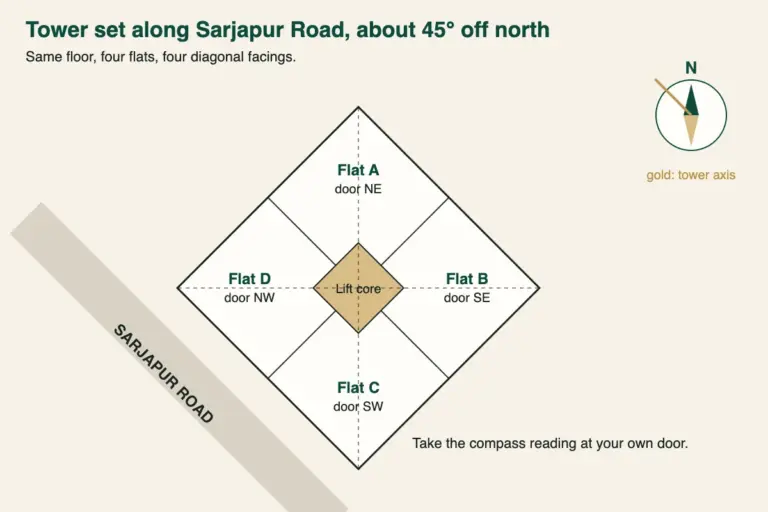
Read your own unit, exactly as for a flat in India. The facing of the building matters less than where your own front door falls and where the kitchen and main bedroom sit inside.
Apartment buyers in Australia pay more for a north-facing balcony, and for good reason: it is the sunny one. In Vastu terms that balcony is also on the side that should stay open, so keep it uncluttered, with low pots rather than a storage box or a barbecue piled in the corner. If your balcony faces south, it will be the cool, shaded side; use it for heavier planters, which Vastu is happy to see there.
What about homes close to the equator, like Singapore or Nairobi?
The same rules, with no flip at all. Near the equator the noon sun passes almost overhead, a little north for part of the year and a little south for the rest. That is one more reason I tie the zones to the directions and not to the noon sun: if the rules depended on the sun’s side, a house in Singapore would change its Vastu twice a year.
Do I use true north or magnetic north in the southern hemisphere?
True north. In India the gap is about a degree, so I read the compass as it is. In most of Australia, New Zealand and South Africa the gap is 10 to 25 degrees, enough to put a room in the wrong zone. Turn on true north in your phone’s compass, or look up your declination on NOAA’s calculator. My guide to reading a Vastu compass at the main door shows the method, and the 16 zones of Vastu by degree show why a few degrees matter.
Do the door padas and sleeping direction change south of the equator?
No. The main door padas, the sleeping direction and the room rules are exactly as in India. Head to the south is best for sleep, east is good for children and students, west is a last resort and north is to be avoided. These rest on directions, which do not flip. A compass needle points north in Sydney exactly as it does in Delhi, because the earth’s magnetic field does not reverse at the equator. So the usual reason given for not sleeping with your head to the north applies here too.
That means my pages on main door Vastu and the 32 door padas, which direction to sleep as per Vastu and Vastu for the kitchen stove and sink apply to your home as written. The broader guide for families abroad is Vastu and astrology consultation for NRIs, and for American homes there is a separate page on Vastu for homes in the USA.
How do I plan a new build in Australia or New Zealand with Vastu?
Bring Vastu in at the concept drawing stage, before the energy rating and engineering are done. Then the zone rules and the sun rules can be fitted together once.
- Correct the site survey to true north, and confirm the declination.
- Mark the 16 zones on the block.
- Put living areas and the big glass on the north and east.
- Place the kitchen cooktop in the south-east, or the north-west.
- Place the master suite in the south-west, insulated well.
- Keep the stairs on the south or west, and the centre of the house open.
- Shade the west glass for the afternoon sun.
In Perth or Brisbane, where summers are long and hot, the west matters more than the south. A solid, well-shaded west wall suits both the heat and Vastu.
Does the best facing for my rashi change in the southern hemisphere?
No. The pairing of each rashi with a direction comes from the rashi’s ruling planet and the planet of each direction, and neither depends on which side of the equator you live. A Leo native in Brisbane reads the same direction as a Leo native in Bengaluru. My page on which facing house suits your rashi applies as written, and if you want that read against your own chart, the session for it is Astro-Vastu consultation.
Where the birth chart does need care abroad is the time and place of birth. If you were born in Australia or New Zealand, give me the local time on your birth certificate and the city; the chart is calculated for that place, with daylight saving taken into account where it applied.
How does a session work from Australia, New Zealand or South Africa?
Online, on a 45-minute video call, with a written report within 48 hours. Australia’s east coast is four and a half to five and a half hours ahead of India, so your afternoon or evening is my morning or afternoon. New Zealand is six and a half to seven and a half hours ahead, and South Africa three and a half hours behind.
Send me the floor plan, a true-north compass reading at the front door, a few photos and the address. One floor is ₹1,499, and your bank converts it when you pay online. What we cover is on my online Vastu consultation for homes page.
What do clients say after a session?
“Great experience with AlignAura. The consultation was clear, detailed, and easy to understand.”
Abhishek Sharma, Google review, October 2026
Reviews are left by clients after their session, in their own words; I don’t write or script them. Google reviews of AlignAura.
Frequently Asked Questions
Does Vastu work in Australia?
Yes. I use the same zones and directions as in India, correct the compass to true north, and use the sunny north side for light and warmth.
Should the main door face south in the southern hemisphere?
Not because of the hemisphere. The door rules are the same as in India: every wall has good padas, and a south door is fine on Vitatha or Grihakshata, the third and fourth padas from the south-east corner.
Is a north-facing house good in Australia?
Yes. It is good in Vastu and it gets the winter sun on the front. Keep the north and north-east open and bright.
Why do some Vastu consultants reverse the rules south of the equator?
Because the noon sun is in the north there. I do not reverse them, because sunrise is still in the east and north is still the same axis. Each direction keeps its planet.
My south-west bedroom is cold in winter. Should I move it?
No. Insulate and warm it with heavier curtains, a rug and warmer colours. The south-west wants weight, so this suits the zone.
What is the magnetic declination in New Zealand?
It is large, about 20 degrees east in Auckland and more further south, so always correct the compass to true north before reading the zones.