
Short answer: To check the direction of your house, stand in the main doorway facing out, hold your phone flat and read the compass. The number you see is the facing: near 0 is north, 90 east, 180 south and 270 west. The free Vastu compass below reads it live, or tells you the facing from a number you type in.
Updated 3 November 2026
Free Vastu compass: how do I use it?
Open this page on your phone, tap Start, and keep the phone flat with its top edge pointing out of the main door. If your phone will not share its compass with a web page, use any compass app instead and type the degree into the second box.
Live compass
—°
Tap Start to read your phone’s compass
This live reading is your phone’s magnetic north. In India it is within about a degree of true north, so use it as it is. Abroad, type a true-north reading into the box below instead.
Nothing you enter leaves your phone. This tool has no tracking and stores nothing.
It works best in Chrome on Android and Safari on iPhone. An iPhone asks for motion access the first time; that is the phone’s own permission.
How to check the direction of a house, step by step
Stand at the main door, look out, and read the compass three times. The steps below stop the common slips.
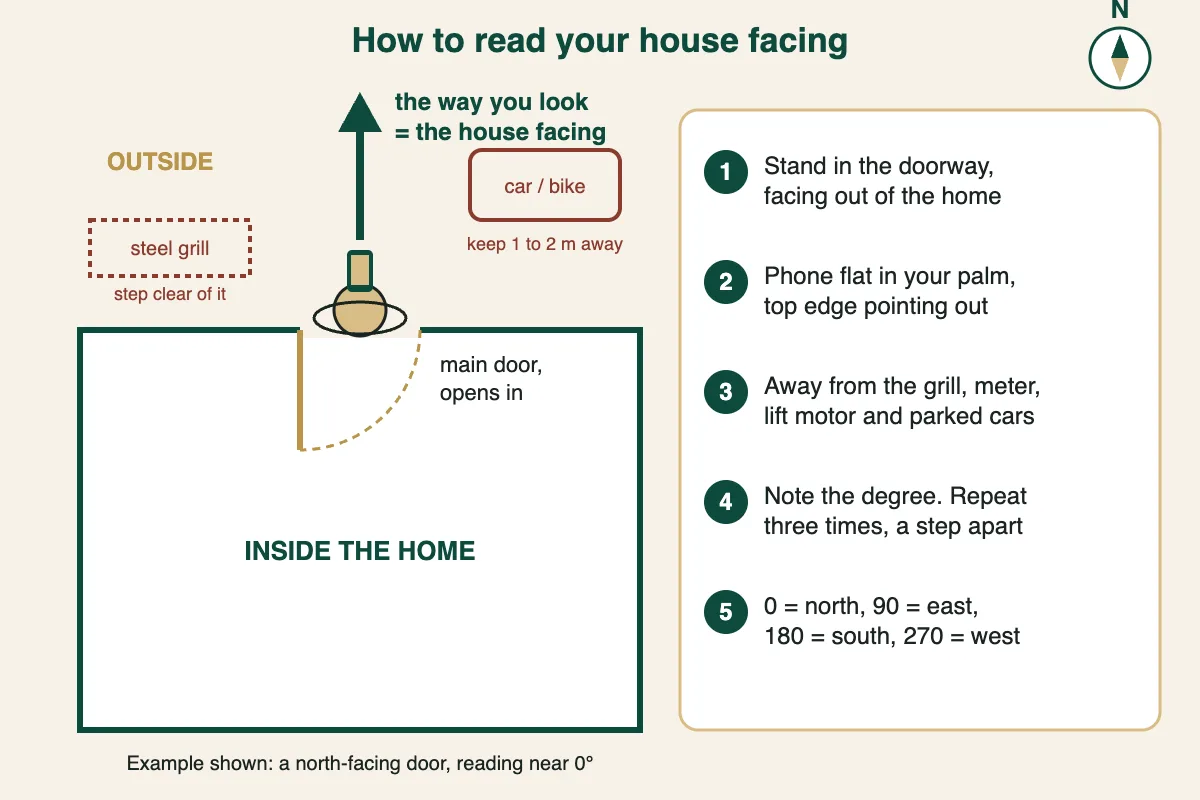
- Calibrate the phone once, usually by moving it in a figure of eight.
- Stand in the main doorway, or a step inside it, with your back to the home and your face towards the street or the corridor.
- Hold the phone flat in your palm, screen up, top edge pointing straight out. A tilted phone reads badly.
- Move clear of metal. The steel grill, a safety door, the meter board, a lift shaft and parked cars all pull the needle.
- Note the number. Take a step to the side and read it twice more. If all three agree within about five degrees, that is your facing; if not, one spot is near metal.
Why is a house’s facing the way you look when you step out?
Because the facing names the side the entrance opens onto. When you walk out of the main door, you are walking towards that side, so the direction your face points is the facing.
Families mix this up all the time: someone stands in the hall looking at the door, reads “north” and calls the house north facing, when it actually faces south. If you took it looking in, add or subtract 180. The manual box does that for you.
In a flat, the facing is your own front door, not the tower’s entrance or the balcony.
What do the compass degrees mean for a house facing?
Each facing owns a range of degrees around its centre point. A reading close to the centre is a clean facing; a reading in the gap between two is a leaning one, and I read both.
| Facing | Clean reading | In-between (read both guides) | My guide |
|---|---|---|---|
| North | 350 to 10 | 10 to 35, between north and north-east | north facing house Vastu and door padas |
| North-east | 35 to 55 | 55 to 80, between north-east and east | north-east facing house Vastu |
| East | 80 to 100 | 100 to 125, between east and south-east | east facing house Vastu plan |
| South-east | 125 to 145 | 145 to 170, between south-east and south | south-east facing house Vastu |
| South | 170 to 190 | 190 to 215, between south and south-west | south facing house Vastu: good or bad |
| South-west | 215 to 235 | 235 to 260, between south-west and west | south-west facing house Vastu remedies |
| West | 260 to 280 | 280 to 305, between west and north-west | west facing house Vastu plan |
| North-west | 305 to 325 | 325 to 350, between north-west and north | north-west facing house Vastu |
A reading of 74, say, is not “east” to me. It is east leaning north-east, and that can move a door from one pada to the next. Write down the number, not just the word.
What are the 16 zones on a Vastu compass?
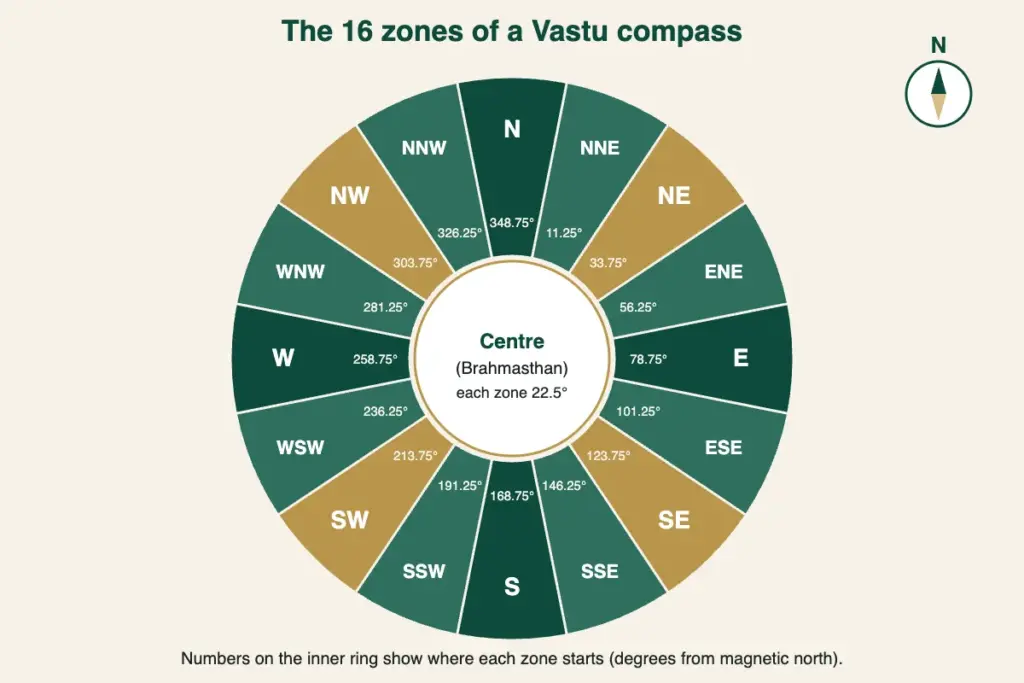
The 16 zones split the full circle into slices of 22.5 degrees each, measured from the centre of the home. The live compass names the zone your phone is pointing into.
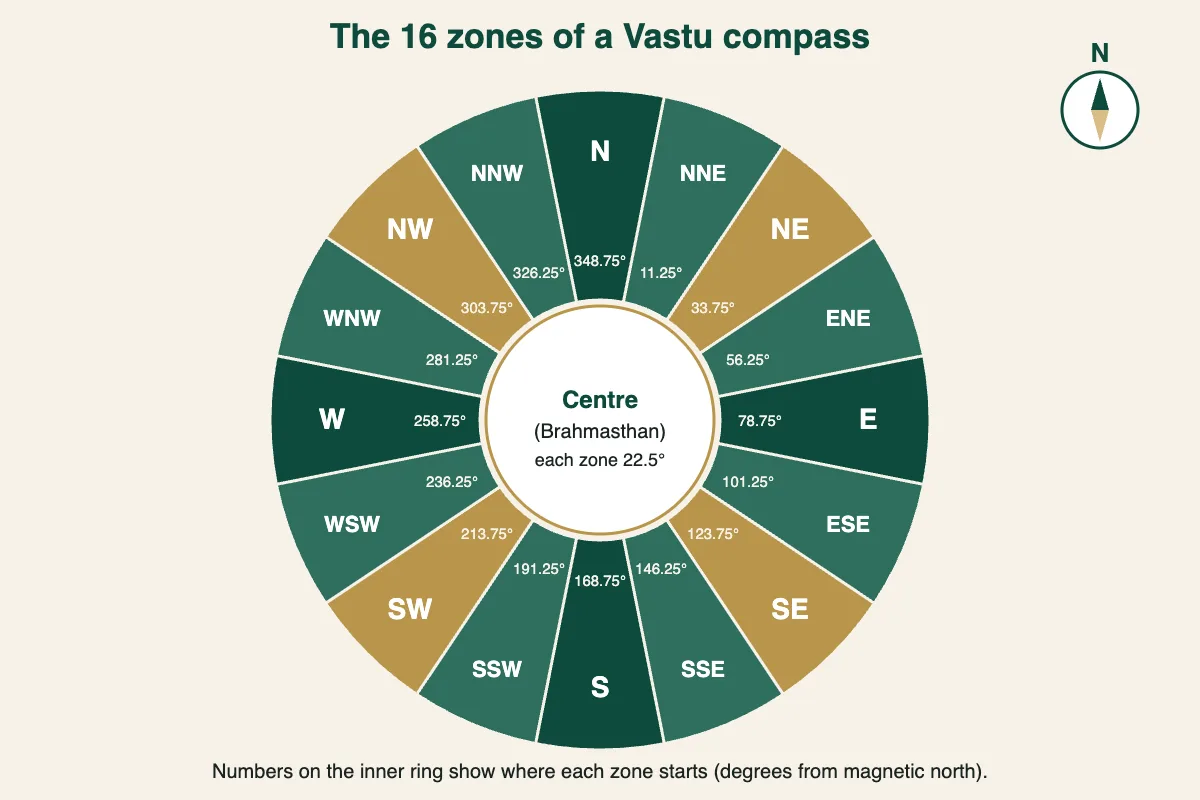
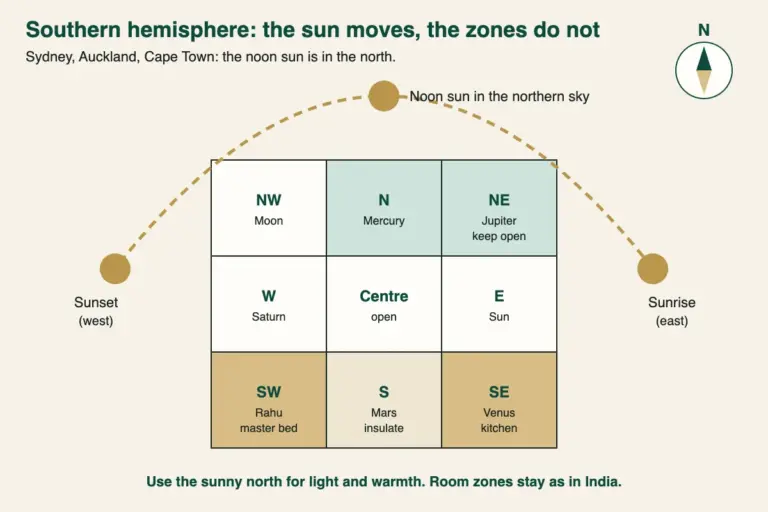
Each of the eight directions splits in two to make these zones. Which rooms belong in which slice is on my page on the 16 Vastu zones and how I read a floor plan.
True north or magnetic north for Vastu?
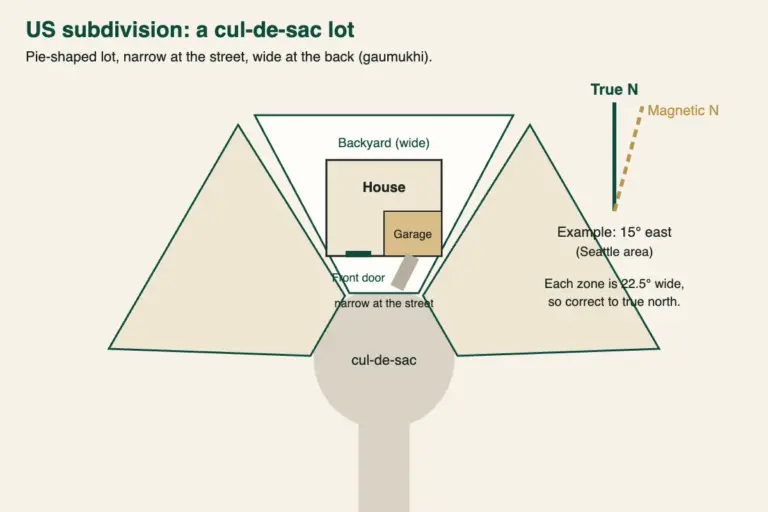
I read Vastu from true north, the direction of the earth’s axis and the one maps use. Vastu’s directions come from the sun’s path, so that is the reference. Magnetic north is what a needle compass, and many phone compass apps, point to.
The gap between them, called declination, is about a degree across India, and each of the 16 zones is 22.5 degrees wide, so in India any phone or compass reading is fine as it is. Abroad the gap can be large: 10 to 15 degrees in much of the United States, where I correct every home to true north, east of true north in Seattle and west of it in Boston, and about 20 degrees in New Zealand.
For a home abroad, switch your phone to true north before you take the reading (on an iPhone: Settings, Compass, Use True North; Google Maps on Android already corrects for your location), or send me the plain compass reading with your city and I correct it. My notes on Vastu and astrology for NRIs living abroad cover the rest of an overseas reading.
Which pada is my main door on?
Split the front wall into eight equal parts, counted from the corner on your left as you look out, and see which part the door opening sits in. The manual box above does the arithmetic.
A pada is one of the 32 squares in the outer ring of the Vastu Purusha Mandala, the square grid that sits behind every Vastu plan. Some sites count nine per wall. That is the same ring drawn as a 9 by 9 grid, where each corner square gets counted on both walls. Give each corner to one wall and you get eight per wall, 32 in all, which is how I count. The verdict for each pada is on my main door Vastu guide to the 32 entrance padas.
Measure the front wall, the distance from the left-hand corner to the door frame, and the door’s width, all in one unit. A door covering two padas is read for both.
Common mistakes when you check house direction with a phone
Nearly every wrong facing I see comes from one of these six.
- Reading while looking in, then not turning the number round.
- Standing beside the steel safety door or grill, which can swing a reading by 30 degrees.
- Holding the phone upright like a camera instead of flat.
- Using a magnetic phone cover or a car mount magnet.
- Trusting the builder’s brochure. Flats sold as “east facing” often look out to the south-east.
- Taking the facing of the gate or the compound wall instead of the door of the home itself.
How do I mark north on a floor plan?
Draw an arrow on the plan pointing to 0 degrees, worked out from your door reading.
- Find the main door on the plan and draw a short line straight out from it. That line is your reading, say 74 degrees.
- North is 74 degrees anticlockwise from that line. Turn a protractor, or a free protractor app, from the line by that amount and draw an arrow. Mark it N.
- Check it against a second reading taken at a window on another wall. The two should agree.
- Write the exact degree beside the arrow, such as “door at 74°”.
Once north is on the plan, my room-by-room Vastu for home guide tells you what each corner is for. If you are still choosing between flats, take the reading before you pay anything.
Which three photos should I send for an online Vastu consultation?
Send three compass screenshots: one at the main door, one in the middle of the home and one near a window. If they agree, I can draw the zones without visiting.
- Main door: stand in the doorway facing out, phone flat, and take a screenshot when the number settles. If you would rather stand outside and look in at the door, that works too. Just tell me which way you were looking.
- Middle of the home: stand roughly at the centre, point the top of the phone the same way as the main door, and take a second screenshot.
- Near a window: pick a window on a different wall, keep clear of the frame, point the phone the same way again and take the third.
Keep the degree visible in each screenshot. If they differ by more than a few degrees, I ask for one more. Along with these, I need the floor plan or a hand sketch and a few room photos, which is the same list as on my online Vastu consultation for homes page.
Send me your reading and I will do the rest
Send me the three screenshots and your plan, and I will mark the 16 zones, place every room and door, and tell you what to change without breaking a wall. Home Vastu is ₹1,499 for one floor or one flat, on a 45-minute call online or at my Begur studio, and the written report follows within 48 hours. You can book a home Vastu session with me whenever you are ready.
Frequently Asked Questions
Which is the best compass app for Vastu?
Any compass app that shows degrees will do, including the one built into your phone. What matters is calibrating it, holding the phone flat and keeping away from metal. Avoid apps that only show N, E, S and W without a number.
How do I find the direction of my house without a compass?
Open a map app with north at the top and see which way the front door looks, or note where the morning sun comes in. Both are rough; for Vastu I still want a compass number.
Is the Vastu compass on this page accurate?
It is as accurate as your phone’s own sensor. Calibrate, take three readings a step apart and stay clear of metal.
Why does my phone show a different direction in different rooms?
Steel in beams, wardrobes, fridges and wiring bends the reading. A few degrees is normal; a big jump means metal nearby, so trust the readings that agree.
Should the reading be taken inside or outside the main door?
Take it in the doorway or one step inside, facing out, as long as you are clear of the steel frame. If a grill or safety door is right there, step outside it. The direction you face is what counts, not which side of the threshold you stand on.
How do I check the direction of my flat in an apartment?
Stand at your own flat’s front door, face out into the corridor, and read the compass. Lift shafts and steel railings sit close to most flat doors, so take your readings a little away from them.
Does a few degrees really matter in Vastu?
For the facing, rarely. For a door near the edge of a pada, or a room on a zone line, yes, a few degrees can change the reading. That is why I ask for the exact number.
Why does the compass not work on my laptop?
Laptops and most tablets have no magnetic sensor inside. Open this page on your phone, or read the degree from a compass app and type it into the manual box here.