

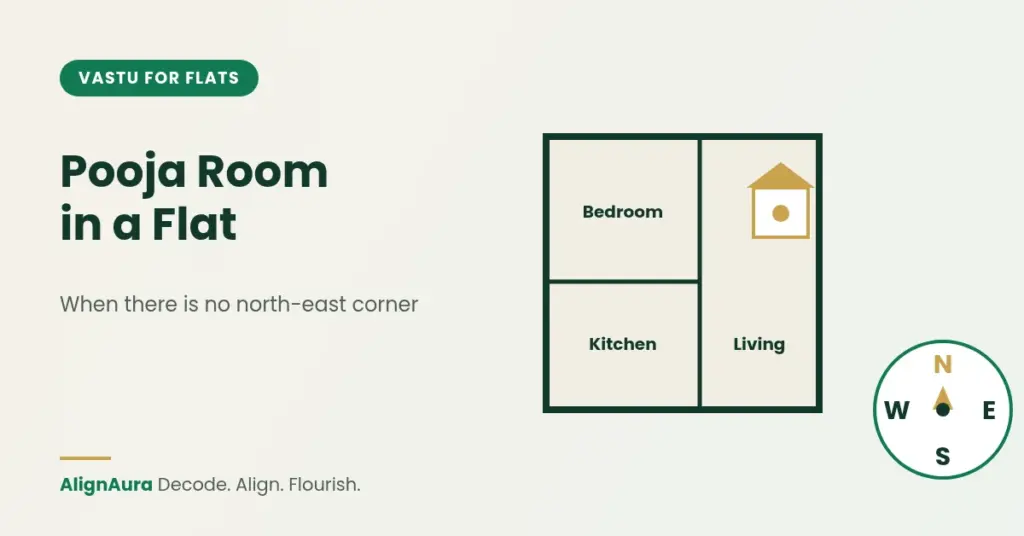
Short answer: The best pooja room position is the north-east, then the east or north. Face east or north while praying, so the idols face west or south. In a flat with no spare north-east, use the north-east of the living room or a clean east or north wall, and avoid toilets, bedrooms and stairs.
Pooja room Vastu: where it goes in any home
The first choice is the north-east of the home, the corner Vastu calls Ishan. After that comes the east, then the north. Sit or stand facing east or north while you pray, which means the idols face west or south. Keep the idols raised off the floor with a small gap from the wall, and keep the spot clean and well lit.
Why the north-east? It is the water corner, it gets the morning light, and it is ruled by Jupiter, the planet of guidance and prayer. That is why it ranks first for a mandir, and why I treat clutter in that corner as the first thing to clear in any home.
Jupiter is also a planet in your birth chart, and its strength there differs from person to person. Two families can keep the mandir in the same north-east corner, and for one of them that corner will matter more than for the other.
Pooja room position when the flat has no north-east to spare
In apartments the north-east is very often taken: a bathroom, a balcony, a bedroom or a cut in the plan. You can still have a good prayer space. You work with the zones you have, in this order:
- The north-east of the living room. Every room has its own corners. The living room is shared, used in daylight and usually kept clean, so its north-east is the best stand-in.
- A clean stretch of the east or north wall. Useful when the corner is taken by a door, sofa or TV. The west wall is acceptable only when nothing else works.
- A wall-mounted mandir. In a compact 2BHK it is often the best answer: no floor space, above the clutter, and fixed exactly where the direction is right. Mount it so the idols sit at about chest height when you pray.
- The north-east of the dining area or study. Fine if the spot is calm and stays tidy.
Pooja room by flat facing
The facing of the flat does not change where the mandir goes. It changes where the north-east usually falls in the plan, and that is why buyers ask the question by facing.
| Flat facing | Where the north-east usually is | What I suggest |
|---|---|---|
| East-facing | Close to the entrance and living room | North-east of the living room, but out of the direct line of the main door |
| West-facing | At the back, often a bedroom or a bath | North-east of the living room, or the east wall of the dining area; idols on the east wall facing west |
| North-facing | Near the entrance side | North-east corner if it is not the shoe or passage area; else the north wall of the living room |
| South-facing | At the far end, usually a bedroom | East wall of the living or dining area; a closed unit in the bedroom only as a last resort |
People in west-facing homes often ask me if the pooja room must face the main door. It should not. In a west-facing flat, put the mandir on the east side so that you face east while praying, and keep it away from the line of the west door. More on the rest of that layout is in my west-facing house guide. In an east-facing house the north-east is often close to the entrance, so keep shoes well away from it.
Duplex homes: can the pooja room be on the first floor?
Yes. In a duplex or an independent house, a pooja room on the first floor is acceptable when it sits in the north-east of that floor, is not directly over a toilet or the kitchen stove, and is not on the staircase landing. Many families still prefer the ground floor because older parents can reach it every day without the stairs, and I think that practical reason counts. What I advise against is the space under the staircase, which is common in duplexes.
Many Kolkata families keep the thakurghar on the roof; if yours does, give it the north-east of the roof. I read these homes on my Kolkata home Vastu page.
Places to avoid for a mandir
- Under the staircase, with weight and footsteps overhead.
- A wall shared with a toilet. Check what is on the other side before you drill.
- Directly below a toilet on the floor above, when you can find out from the plan.
- The bedroom, if there is any other option. If it is the only place, use a closed unit with doors or a curtain, and make sure your feet do not point towards it while you sleep.
- Inside a kitchen cabinet beside the stove. A small shelf in the kitchen’s north-east is a last resort only.
- The south-west and the centre of the home.
- Straight opposite the main door. Visible is fine; in the line of entry is not.
Keep wind chimes away from the mandir too; a small bell is the sound that belongs here, as I note in where wind chimes should not hang.
A setup checklist for the mandir
| Step | What to do |
|---|---|
| 1 | Find the north-east of the flat with a compass reading from the centre |
| 2 | If it is taken, find the north-east of the living room |
| 3 | Check what is behind the wall you plan to use |
| 4 | Use a wall unit or low platform so the idols are off the floor |
| 5 | Leave a small gap between the idols and the wall |
| 6 | Keep a few idols or pictures; retire broken ones respectfully |
| 7 | Use white, cream or pale yellow around the mandir |
| 8 | Keep unrelated storage away from below and around it |
| 9 | Place the diya where curtains cannot catch it |
Diwali and Varalakshmi: setting up the Lakshmi-Ganesh puja
Diwali falls on 8 November 2026, with Dhanteras on 6 November. For the Lakshmi-Ganesh puja, keep the idols together on a clean raised chowki in the north-east or the north of the room, facing west or south, so that the family faces east or north during the puja. The cash box or account books usually sit close by in the north. The order of the idols follows your family’s custom, and I would not change a tradition your elders follow. My Diwali Vastu tips cover the entrance and the lamps as well.
Families in Karnataka who keep Varalakshmi Vratam in August can use the same spot and the same facing. The kalash and the decorated face of the goddess sit on the chowki, and the person doing the vratam faces east.
What can and cannot be fixed without construction
Almost everything about a pooja space can be arranged without a mason. You pick the wall, the height, the facing and what you keep around it. What a mandir cannot do is cure the plan: if the north-east of the flat is a toilet or is cut, the prayer corner will not undo that by itself. Those need their own remedies, which I cover in common Vastu mistakes in flats and in the room-by-room guide to Vastu for home.
From my consultations: the pattern I see most often in flats is a mandir placed wherever there was space, often on a wall shared with a toilet, and simply moving it to the north-east of the living room usually feels right to the family straight away.
The prayer corner and Jupiter in your chart
A plain Vastu reading tells you where the mandir fits best in your plan. Reading your birth chart as well tells me how much that corner carries for you right now. The north-east belongs to Jupiter, so when Jupiter is a key planet in your chart or you are running its period, the state of that corner climbs my list.
A typical case: a flat where the north-east is a bathroom, for a family member in a Jupiter mahadasha. There I would not stop at moving the mandir; easing that bathroom would come first. If you want the chart and the home read together like this, see my Astro-Vastu consultation. A ₹1,499 home session is the easy way to start.
If you need help finding the right spot, book a home Vastu session. It is ₹1,499 for one floor or flat, 45 minutes online or at my Begur studio, with a written report within 48 hours. Clients across India send me the plan and photos; Bengaluru families can also see my Vastu consultation in Bangalore.
Frequently Asked Questions
Can the mandir face the main door?
It is better not to. The mandir can be visible from the entrance, but it should not sit straight in the line of the door, where people walk in with shoes and bags. A little to one side, on the east or north wall, is usually enough.
How high should a wall mandir be fixed?
Fix it so the idols are at about chest height when you pray, standing or seated, whichever you do most. Too low and it gathers dust and clutter; too high and you end up looking up at it. Keep a small gap behind the idols.
Can I keep photos of ancestors in the pooja room?
Most families keep ancestors’ photos apart from the deities, on a south or west wall of another room. That is the traditional practice and the one I suggest. If space is tight, keep them on a separate shelf rather than among the idols.
Which colour suits a pooja room?
Light shades work best: white, cream, pale yellow or a soft wood finish. Avoid dark greys and black around the mandir. Good light matters as much as colour, so a small lamp or a window nearby makes the corner feel right.
Is a glass or marble mandir better than wood?
Any clean, sturdy material works. Wood and marble are the most common choices, and both are fine. Pick one that is easy to keep clean and suits your space. The position and upkeep matter far more than the material.
Lighting the first diya of the season? My Diwali Vastu tips for 2026 cover the pooja corner, the entrance and where to place the lamps.