
Short answer: As per Vastu, hang a metal wind chime with 6 or 8 rods in the west, north-west or north, and a wooden or bamboo chime with 3 or 4 rods in the east or south-east. Hang it above head height near a window, balcony or the inside of the main door. Never hang one above a bed, a sofa seat or a chair.
Updated 3 November 2026
Are wind chimes part of Vastu at all?
Not of classical Vastu. Wind chimes come from Chinese feng shui; Indian homes had temple bells and the ghungroo, not hanging tubes.
I still place them, because they are now in half the homes I see and the question is a fair one. My method is to read a chime as what it is, a sound and a material, and place it with the Vastu element of each direction. I won’t tell you a chime brings wealth. A good one in the right spot makes a corner feel lighter and gives you a pleasant sound when the breeze comes in. A bad one in the wrong spot is noise over your head.
Wind chimes Vastu direction: where should they hang?
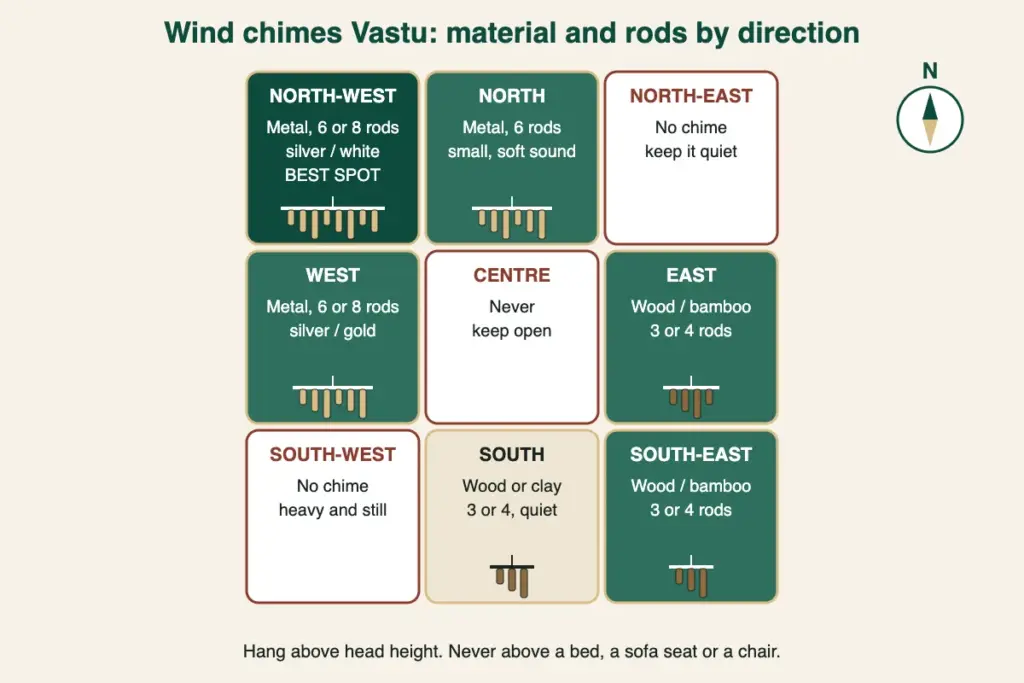
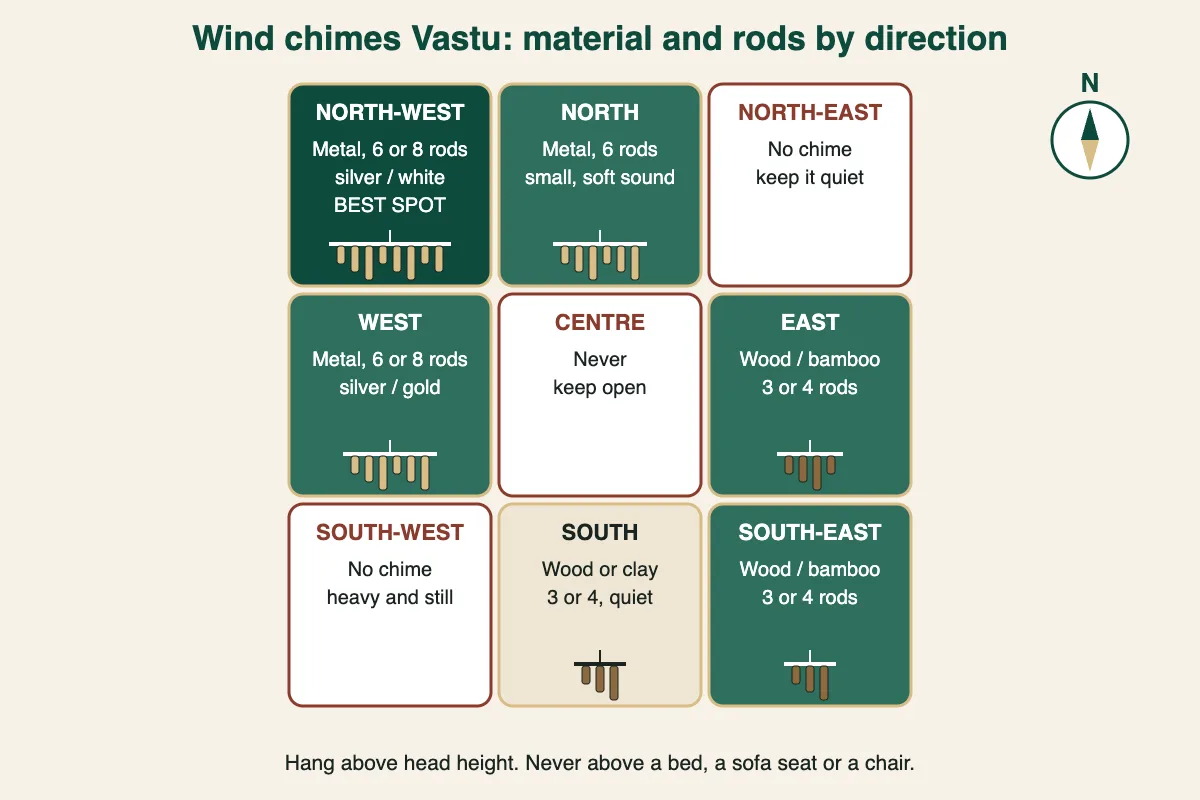
Metal chimes go west, north-west or north; wooden and bamboo chimes go east, south-east or south. I keep the south-west, the north-east and the centre of the home free of them.
The reason is the element map Vastu gives each direction: water in the north, wood in the east, fire in the south-east, earth in the south-west, metal in the west and air in the north-west. A metal chime belongs with metal and air. A wooden one belongs with wood, and with the fire of the south-east that wood feeds. The north-west is the zone I like most for any chime, because air is what makes it ring.
How many rods should a wind chime have, and which metal?
Six or eight rods for a metal chime, three or four for wood or bamboo. The metal can be aluminium, brass or steel; what matters more is a clean, soft tone.
The rod counts come from feng shui, and you will see shops argue over five, six, seven and nine. I keep one rule so clients are not left guessing: six or eight hollow metal rods in the west and north-west, three or four wooden ones in the east and south-east. Brass gives a warmer note; aluminium is lighter and rings in the smallest breeze, which suits a flat with little wind.
| Direction | Material | Rods | Colour | My view |
|---|---|---|---|---|
| North-west | Metal (aluminium, brass) | 6 or 8 | Silver, white, grey | Best spot for a chime |
| West | Metal | 6 or 8 | Silver, white, gold | Good |
| North | Metal, small and soft | 6 | Silver, light blue | Good, if the sound is gentle |
| East | Wood or bamboo | 3 or 4 | Natural wood, green | Good |
| South-east | Wood or bamboo | 3 or 4 | Natural wood, soft orange | Good |
| South | Wood or clay | 3 or 4 | Brown, coral | Fair, keep it quiet |
| South-west | None | None | None | Avoid: this zone stays heavy and still |
| North-east | None | None | None | Avoid: I keep it light and quiet |
| Centre | None | None | None | Never: the centre stays open |
The colours follow the same shades I use for walls in each zone, so the chime does not fight the room. My Vastu colours for walls by direction page has the full list. To find which way a window or balcony looks, use my Vastu compass to check any direction.
Other decor follows the same element map; a brass tortoise, for example, sits in the north, as my tortoise Vastu direction guide explains.
Where exactly should I hang a wind chime at home?
Hang it where a little breeze reaches it: a north-west window, a west balcony, or just inside the main door where the door’s movement rings it softly.
- Find the zone with a compass, and pick the material from the table above.
- Choose a spot with some air: a window, a balcony door, or the entrance.
- Hang it above head height, so the lowest rod clears the tallest person in the family. Nobody should duck under it.
- Keep it off the door’s path. At the entrance, hang it to one side, just inside, so the opening door brushes the air, not the rods.
- Listen for a day. If the sound is pleasant, leave it. If anyone at home dislikes it, move it or take it down.
A chime at the main door is popular. Keep it inside the house rather than out in the corridor, and still read the rest of the entrance on my main door Vastu and the 32 padas page. A balcony in the north-west is often the easiest place in a flat; it gets wind, and nobody sits right under it.
Where should you not hang wind chimes?
Never above a bed, a sofa seat, a dining chair or a work chair. Also keep them out of the south-west, the north-east, the centre of the home and the toilet.
- Above where someone sleeps or sits. A swinging object over a person’s head is unsettling, and a chime that rings over a sleeper is plainly bad for sleep. My bedroom Vastu guide to bed placement keeps the space over the bed clear for the same reason.
- In the bedroom at all, ideally. If you love one there, a small wooden chime by the window, far from the bed, and tied still at night.
- South-west. This is the zone of weight and stillness, where the master bedroom belongs. Sound and movement work against it.
- North-east. I keep it calm for prayer and quiet thinking. A gentle bell in the pooja is different from a chime clanging all day.
- The centre. The middle of the home stays open and unhung.
- Over the stove or in the kitchen. Grease settles on it, and the heat dulls it fast.
- In the toilet or bathroom. No.
What should a good wind chime sound like?
Soft, clear and pleasant to everyone who lives there. If the sound grates on even one person, it is the wrong chime or the wrong spot.
Cheap chimes often ring flat and tinny. Try one in the shop before buying; tap it gently and listen for a note that fades slowly. A chime in a windy spot that rings all night will wear on the family, so tie the rods together with a soft cloth at bedtime if you need to. Rusted, cracked or tangled chimes come down; a broken one does more harm to the feel of a room than having none.
Neighbours count too. In an apartment, a loud chime on a shared balcony can sour things next door. Keep the size modest.
Wind chimes for the office or shop: where?
In the north-west or west of the reception or shop, near the door or a window, above head height. Not above a desk or the cash counter.
For a picture in the same reception, see 7 horses painting for an office reception.
In a shop, a light metal chime just inside the entrance lets you hear customers come in, which is a small, real benefit. In an office, keep chimes out of work areas; constant sound breaks concentration. The rest of the layout is in my Vastu for office: desk, cabin and entrance guide.
Does your chart change which chime suits you?
Only in where I look first. The north-west belongs to the Moon, so for someone running a Moon period, or with an unsettled Moon in the chart, I pay more attention to that zone, chime or not.
In those homes I keep the north-west airy and uncluttered, and a soft metal chime there is welcome. A clanging one is not. If you would like that read properly, my Astro-Vastu consultation with your chart and plan looks at both together.
Want me to check the whole home, chimes and all?
Send me your floor plan with north marked and photos of the windows or balconies you are thinking of. I will tell you where a chime fits and, more usefully, what the rest of the home needs. Home Vastu is ₹1,499 for one floor or one flat, on a 45-minute call online or at my Begur studio, and the written report follows in 48 hours. The details are on my online Vastu consultant for homes page; for the room most chimes end up in, see Vastu for the living room, and for every room, my complete Vastu for home guide.
Frequently Asked Questions
Which direction is best for wind chimes as per Vastu?
The north-west is the best, with a metal chime of six or eight rods. West and north are good for metal too. For a wooden chime, use the east or south-east.
Can I hang wind chimes at the main door?
Yes, just inside the door and to one side, above head height. Use metal if the door faces west, north-west or north, and wood if it faces east or south-east.
How many rods should a wind chime have?
I use six or eight for metal chimes and three or four for wooden ones. The counts come from feng shui; the tone and the placement matter more than the number.
Can I hang wind chimes in the bedroom?
I would avoid it. If you want one, keep it small, wooden, by the window and away from the bed, and tie it still at night. Never above the bed.
Are wind chimes good or bad as per Vastu?
Neither, on their own. A soft chime in the north-west or west is pleasant and harmless. A loud one over a bed or in the south-west works against the room.
Can wind chimes be hung on the balcony?
Yes, and a north-west or west balcony is often the best place in a flat. Keep the size modest so the sound does not carry into the neighbours’ homes.
Which wind chime is good for a south-facing house?
At a south door, a small wooden or clay chime with three or four rods, kept quiet. Inside the home, the north-west is still the best spot for a metal one.
What should I do with an old or broken wind chime?
Take it down and recycle the metal or wood. A cracked, rusted or tangled chime only adds a jarring note to the room. Replace it if you still like the sound.