

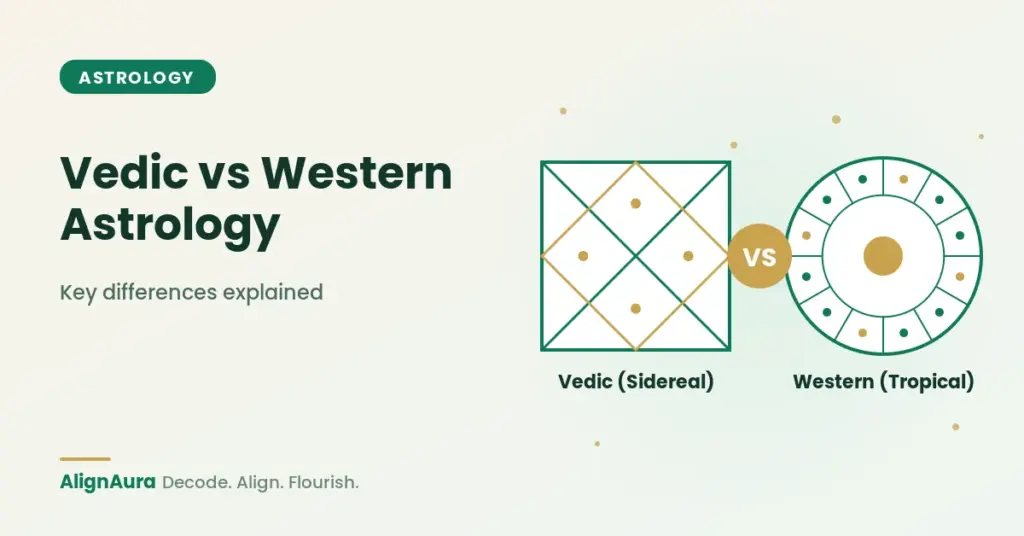
Short answer: The key differences between Vedic and Western astrology are the zodiac and the focus. Vedic astrology uses the sidereal zodiac, which follows the actual stars and now sits about 24 degrees behind the Western tropical zodiac, so for most people the Sun sign moves back by one sign. Vedic astrology also puts the Moon and its nakshatra at the centre and times events with dashas, while Western astrology centres on the Sun sign and on personality.
Most people have read a Western horoscope at some point, usually the sun sign columns in newspapers and apps. Vedic astrology, the system I use in AlignAura’s consultations, works very differently. Here is how the two compare.
1. The Zodiac System
Western astrology uses the Tropical zodiac, which is based on the seasons. The spring equinox marks the start of Aries, wherever the constellations actually sit in the sky today.
Vedic astrology uses the Sidereal zodiac, which follows the actual position of the constellations. Because of the precession of the equinoxes, the two systems are now about 24 degrees apart.
So most people have a different sun sign in Vedic astrology than in Western astrology. If you’re a Western Aries, you’re likely a Vedic Pisces.
2. The Ascendant (Rising Sign)
Both systems use the ascendant, the sign rising on the eastern horizon when you were born. In Vedic astrology the ascendant (called the Lagna) is often the most important factor in the chart. For personality and life path, it usually counts for more than the sun sign.
3. Planetary Periods (Dashas)
Western astrology relies mainly on transits, meaning where the planets are moving right now. Vedic astrology adds Dasha periods: long cycles of 6 to 20 years, each ruled by a different planet. This lets a Vedic astrologer be far more specific about timing. When is a career change likely? When is marriage likely? When will money feel tight?
4. The Moon’s Role
In Western astrology, the sun sign dominates. In Vedic astrology, the moon sign is equally or more important than the sun sign for emotional life, habits and patterns of thinking. Many Vedic astrologers, me included, read a chart from both the ascendant and the moon sign.
5. Predictive Accuracy
Because of the dasha system and sidereal calculations, Vedic astrology tends to be more specific about timing. At AlignAura, I use Vedic birth chart analysis to find your current planetary period, the transits running now and the parts of life they are switching on. That gives you a working plan for the next 1 to 5 years.
Book a Vedic Astrology Consultation
Have your full Vedic birth chart read by Saurabh Sen (IIM Ahmedabad, over a decade of Vedic astrology practice). Message me on WhatsApp → Starting ₹1,499.
The Elemental Framework Behind Vedic Astrology
One reason Vedic astrology gives such usable guidance, especially alongside Vastu, is the Pancha Bhuta framework underneath it. Each planet in Jyotish is linked to qualities from the five classical elements (Earth, Water, Fire, Air, Space). Each of the 27 nakshatra (lunar birth constellations) has its own elemental make-up too. Once I know a person’s nakshatra, I can see which directions, colours, materials and layouts will support them, and which will hold them back.
This is where combining Vedic astrology with Vastu really pays off. The Vastu Purusha mandala gives different areas of life to different directional zones, and a person’s nakshatra shows which of those zones suit them most. Prana, the life force that moves through people and spaces, flows differently depending on the elemental make-up of the person living there. Geopathic stress under a property can strengthen or weaken that flow. Put together, Astro-Vastu becomes a three-part tool for planning your life, not a simple checklist of directions.
Western astrology is useful for psychological insight, but it has no elemental or spatial side. It tells you who you are. Vedic Jyotish also tells you how to set up your surroundings to suit who you are, and that is the step that turns knowledge into change.
See how Saurabh Sen combines Vedic astrology with Vastu in our astrology consultation service, or read about the philosophy behind AlignAura’s approach. You can read what real clients experienced on our success stories page.
A question clients often ask me
“My Western sign and my Vedic sign are different. Which one is right?”
Both are calculated correctly; they use different zodiacs. Vedic astrology uses the sidereal zodiac, which is about 24 degrees behind the tropical zodiac used in Western astrology, so your sign often moves back by one. For dashas and Vastu timing, I always use the Vedic chart. Saurabh
Frequently Asked Questions
Is Vedic astrology more accurate than Western astrology?
They do different jobs, so it depends on what you want to know. Vedic astrology (Jyotish) uses the sidereal zodiac, which follows the actual constellations, and I find it more specific for timing and for understanding karmic patterns. Its 27 nakshatra system adds a lot of detail to personality and compatibility readings. Western astrology uses the tropical zodiac and is good at psychological profiling. For Vastu work and the timing of life events, I rely on the Vedic nakshatra framework.
What is a nakshatra and why does it matter for Vastu?
A nakshatra is one of 27 lunar mansions in the Vedic system, each covering 13°20′ of the zodiac. Your birth nakshatra comes from the Moon’s position when you were born. It shapes your elemental make-up, your strong directions and the kind of surroundings that suit you. In Vastu, knowing a client’s nakshatra lets me personalise zone corrections. A person born in Bharani needs a different emphasis from someone born in Uttara Phalguni, even with an identical floor plan.
Can Vedic astrology predict when Vastu corrections will show results?
Yes, and this is one of the most useful parts of combining Jyotish with Vastu. Planetary dashas (major periods) and antardashas (sub-periods) open windows when you are more open to certain kinds of change. If you make Vastu corrections during a good period for that area of life, results tend to come much faster. I use this timing to advise clients on when to start renovations, move house or make structural changes.
How does Vedic astrology handle compatibility for shared spaces?
Homes, offices and businesses are shaped by everyone who uses them regularly. Vedic astrology maps each person’s nakshatra and elemental make-up. From there I look for zones and arrangements that work for the group without holding anyone back. When a couple’s elemental profiles clash, targeted Pancha Bhuta balancing in the shared zones gives a middle ground that supports both partners.
Is the astrology consultation a live call?
Yes. It is a live 45-minute call with me, by video or phone. The fee is ₹1,499 for one kundli, and your written remedies reach you within 48 hours. Details are on my online astrology consultation page.