
Short answer: In Vastu, a tortoise belongs in the north of the home or room, with its head pointing into the house. A metal or brass tortoise suits the north or north-west, crystal the north or north-east, wood the east, and clay or stone the south-west. Only metal and crystal ones sit in water, and that water is changed daily.
Updated 3 November 2026
Why is a tortoise kept at home in Vastu?
The tortoise stands for patience, protection and a long, steady life. In Indian tradition it is also Kurma, the form in which Vishnu held up the churning mountain on his back.
That image is the reason families keep one: something slow and steady that carries the weight. The modern habit of a brass tortoise in a plate of water mixes this Indian idea with Chinese feng shui, where the tortoise guards the back of the house. Both traditions agree on the mood, and the Vastu side tells us where it fits.
So let me set the right expectation. A tortoise will not settle a loan or win you a contract. It is a small, calm object that suits certain zones of a home, and I am happy to place one when a family likes it. That is all I promise.
Tortoise Vastu direction: where should it be kept?
Keep it in the north. North belongs to water in Vastu, and the tortoise is a water creature, so that is its natural side for any material.
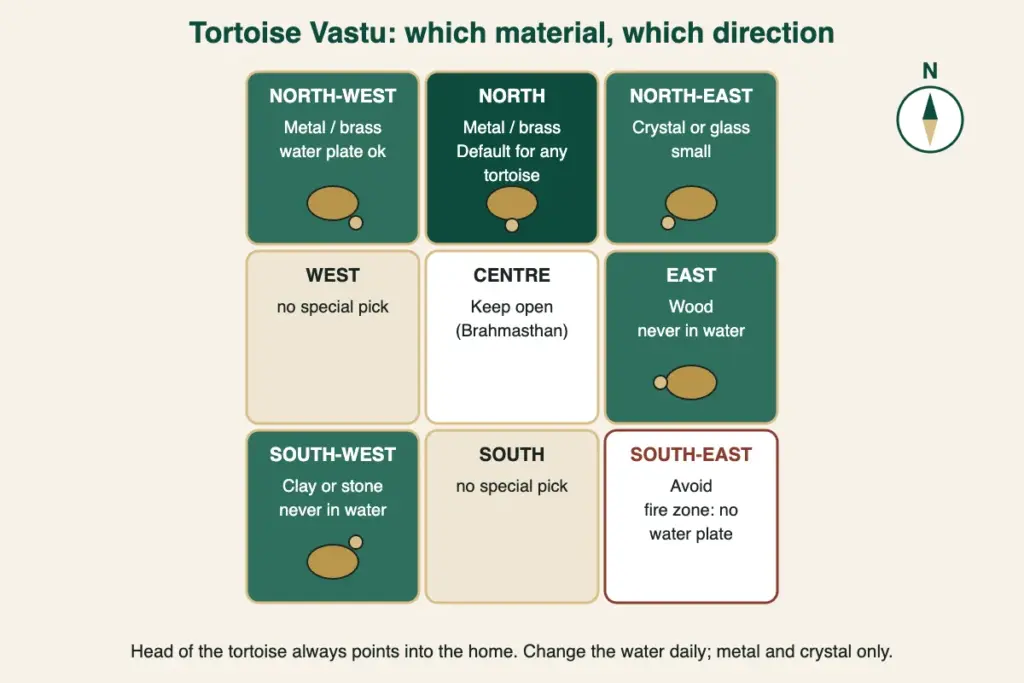
If you know what yours is made of, the material can point you to a better zone. Vastu gives each direction an element: water in the north, wood in the east, fire in the south-east, earth in the south-west, metal in the west and air in the north-west. A tortoise made of something that belongs to a zone sits comfortably there.
Wind chimes follow the same element map, metal to the west and north-west and wood to the east; see wind chimes Vastu by material.
Which tortoise material goes in which direction?
Metal goes north or north-west, crystal north or north-east, wood east, and clay or stone south-west. The table and the map below lay it out with the reason for each.
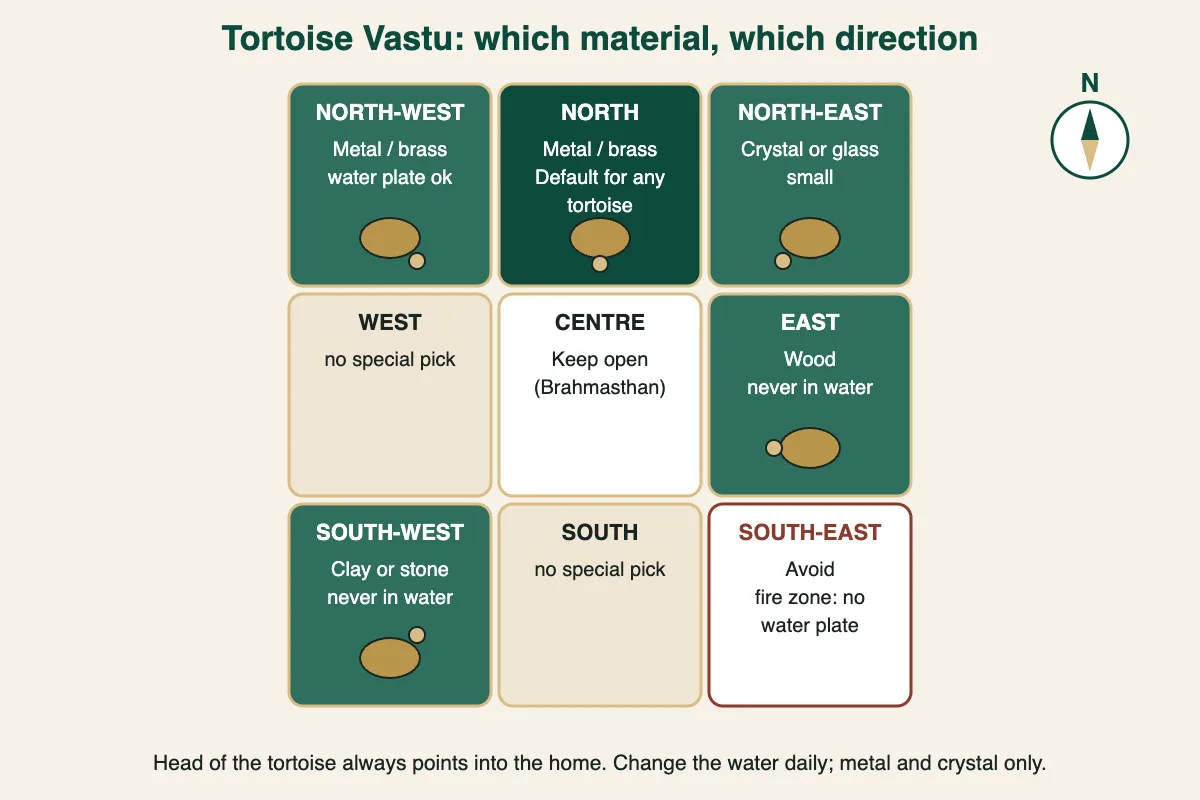
| Material | Best direction | Water plate? | Traditionally kept for |
|---|---|---|---|
| Brass, bronze, copper or silver (metal) | North, or north-west | Yes, a shallow one | Work, new openings, steady income (north); support from people (north-west) |
| Crystal or glass | North or north-east | Optional | A calm, clear corner for study or reflection |
| Wood | East | Never | Health and the family’s daily routine |
| Clay, terracotta or stone | South-west | Never | Steadiness and patience at home |
| Not sure | North | Only if metal | The safe default for any tortoise |
The “kept for” column is the traditional reading, not a guarantee. The direction is what I actually check. Find the directions of your rooms first; my Vastu compass for finding room directions does that on your phone.
Should the tortoise face inside or outside the house?
Inside. The head should point into the home or into the room, as if it has just walked in. A tortoise facing out of the main door reads as walking away.
At the entrance, place it just inside the door with its head towards the house. On a desk, its head points towards you or into the room, not at the door. If you have a tortoise on a shelf against the north wall, turn it so it faces the room rather than the wall.
How do I keep a tortoise in water, as per Vastu?
Only a metal or crystal tortoise goes in water. Use a shallow brass or glass plate, add just enough water to wet the feet, and change it every day.
- Pick a plate a little wider than the tortoise, brass or glass, without cracks.
- Place it in the north of the room or at the north side of the living area.
- Pour in clean water, about a centimetre deep. The shell should stay dry.
- Change the water every morning. Stale, cloudy or green water is the one thing worse than no water.
- Wipe the plate and tortoise once a week. A brass tortoise darkens; a little lemon and salt brings it back.
- Going away for a week? Empty the plate and keep the tortoise dry until you return.
Wood and clay never sit in water. Wood swells and rots, and clay softens and grows mould, and a decaying object is the opposite of what a tortoise is meant to stand for. If you also keep an aquarium, see my aquarium Vastu: direction and number of fish page; the two can share the north side of a room without crowding each other if you keep some distance.
Where should you not keep a tortoise?
Keep it out of the south-east, the bedroom, the kitchen, the toilet and the centre of the home. Also skip any spot on the floor where it gathers dust or gets kicked.
- South-east. This is the fire zone, where the kitchen belongs. A tortoise sitting in water there sets water against fire.
- Bedroom. I keep bedrooms free of symbolic objects. If you want one there, a small dry metal tortoise on the north side is the most I would allow.
- Kitchen. Heat, oil and steam, and the same water-and-fire clash.
- Toilet and bathroom. Never.
- The centre of the home. The brahmasthan, the middle of the plan, stays open. My notes on keeping the brahmasthan open explain why.
- Chipped or broken. A cracked tortoise goes. Replace it, don’t glue it.
How many tortoises, and how big?
One is enough. A pair is fine if you like them, but a shelf of ten turns a calm symbol into clutter.
Size should suit the room: palm-sized for a shelf or desk, a little larger for a living-room side table. A very large stone tortoise belongs outside, in the south-west of the garden or plot, where weight is welcome. Some families also like the small tortoise-on-a-plate figure with a lid holding a coin; I read it exactly as I read a metal tortoise.
Tortoise at the office desk or shop: where?
On the north side of the desk, facing you. In a shop, on the north side of the counter, facing into the shop rather than out of the shutter.
A dry metal tortoise is the practical choice at work, because a water plate on a desk gets knocked and forgotten. The rest of the desk, the chair and the cash drawer follow the rules in my office Vastu guide for desks and cabins, and the cash drawer itself has its own page on locker and cash direction in Vastu.
Does your birth chart change where it goes?
A little. North is Mercury’s direction, so for someone whose work hangs on Mercury (trade, writing, numbers) the north of the home deserves a clean, uncluttered look before any object goes there.
A tortoise is a small part of that picture. When I read a chart beside a plan in my Astro-Vastu consultation for home and chart, I’d much rather clear a blocked north than add an object to it.
Want me to look at the whole home?
A tortoise is the last touch, not the first. Send me your floor plan with north marked, and I will tell you which zones need attention and whether a tortoise, a plant or nothing at all fits there. Home Vastu is ₹1,499 for one floor or one flat, on a 45-minute call online or at my Begur studio, with your written report within 48 hours. See how it works on my online Vastu consultation for your home page, or browse the rest of the rooms in my Vastu for home guide, room by room. Plants are often the better first choice; my Vastu plants for home by direction page has those.
Frequently Asked Questions
Which direction should a tortoise face as per Vastu?
Its head should face into the home or the room. Place it in the north of the room, turned so it looks inwards, and never facing out of the main door.
Where should a metal tortoise be kept?
In the north, or the north-west. Metal belongs to the west and north-west in the Vastu element map, and the tortoise belongs to the north’s water, so both work. A shallow plate of water is fine for metal.
Where should a crystal tortoise be placed?
North or north-east, kept small. A clear crystal piece suits these light, open zones. Keep it dusted; a cloudy crystal loses the point of being clear.
Can a wooden tortoise be kept in water?
No. Wood swells, cracks and rots in water. Keep a wooden tortoise dry, in the east of the room.
Can I keep a tortoise in the bedroom?
I’d rather you didn’t. If you want one there, use a small dry metal one on the north side of the room, away from the bed, and no water plate.
How often should I change the tortoise water?
Every day. A centimetre of clean water, changed each morning. If you cannot keep that up, keep the tortoise dry; dry is better than stale.
Is it all right to keep a tortoise received as a gift?
Yes. A gifted tortoise is read the same as one you bought. Check the material, place it accordingly, and keep it clean.
Should I wear a tortoise ring for Vastu?
A tortoise ring is a popular charm, but it is jewellery, not Vastu, which is about the home. I don’t prescribe one. If you like wearing it, wear it; it does no harm.